
To millions of freshwater anglers across North America, I am the very definition of a springtime obsession: a broad-backed panfish with a soft mouth, a fine table reputation, and just enough schooling instinct, moodiness, and seasonal movement to keep even experienced fishermen guessing. Humans say my name in many ways—some lovingly, some greedily, and some only when the frying pan is already heating up. I am crappie.
Scientists divide my clan into two close relatives, the black crappie (Pomoxis nigromaculatus) and the white crappie (Pomoxis annularis), but to most humans we are simply “crappie”—or, when we grow large enough to excite them, “slabs.”
We may not be the biggest fish in the lake, nor the hardest fighter that swims in fresh water, but that has never stopped humans from adoring us. Quite the contrary. We are accessible, handsome in our own mottled way, and when conditions are right we can make an ordinary day feel like a feast. And when conditions are wrong, we can vanish so completely that humans begin doubting their tackle, their electronics, and sometimes their sanity. That, too, is part of my story.

Who I Am: Broad, Silvery, and Built for Ambush
I belong to the sunfish family, Centrarchidae, which also includes bluegill, redear, and those louder, brasher relatives of mine, the black basses. But I am built differently. My body is deep, thin, and strongly compressed from side to side, more like a broad dinner plate than a torpedo. This shape lets me turn neatly among flooded branches, dock pilings, weed edges, and standing timber, where much of my life is spent.
My mouth is large for a panfish, and that fact tells you much about the way I live. I am no grazer. I am a predator from an early age, and once I outgrow the tiny drifting creatures of my youth, I become very fond of minnows, young shad, insects, and anything else suitably sized that I can inhale. My eyes are large too, and rightly so. Dim light suits me. Dawn, dusk, cloudy skies, stained water, and shadow lines under cover are all times and places where I feel rather confident.
Humans tell the two chief forms of my kind apart by pattern and build. Black crappies, my clearer-water relatives, tend to wear irregular dark mottling over the body, as if someone flicked ink across silver-green armor. White crappies usually show darker vertical bars and tolerate muddier, slower, and more open water better than their cousins. Black crappies also tend to be a little deeper-bodied and are often found where there is more aquatic vegetation. White crappies are more at ease around turbidity, creek channels, and reservoirs that color up after wind or rain. But we are close kin, and where humans fish for one, they often find the other.
In size, we are not giants, but we are large enough to matter. Most of us who make humans smile are somewhere from eight to twelve inches long, and a fish around a pound is already a respectable individual in many waters. Bigger specimens—true slabs—can stretch well beyond that, and a really old, well-fed crappie has enough height across the shoulders to make a fisherman’s pulse quicken before the fish is even in the boat.
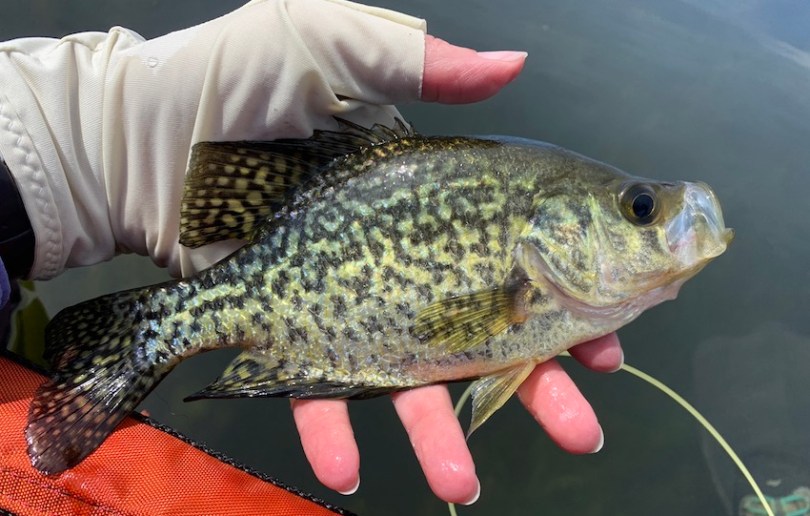
Image credit: Trail’s End Media
Where I Live: Cover, Edges, and Water with a Little Mystery
We are fish of the inland waters of North America, though humans have moved us around so enthusiastically that our present map is wider than our old one. You will find us in ponds, oxbows, lakes, reservoirs, slow rivers, backwaters, and creek mouths. We like places with options: shallow flats for spawning, deeper channels for retreat, cover to suspend around, and forage moving through the neighborhood.
Do not imagine us as fish that simply sit in one brush pile forever. Humans say that about us because they love simple explanations. The truth is subtler. We move according to season, light, temperature, spawning urge, and food. At times we may school tightly over deep brush, a sunken tree, a standing line of timber, or the lip of an old creek channel. At other times we may scatter through shallow cover, cruise beneath docks, or suspend in open water under clouds of baitfish. Often, we are not on the structure humans can touch, but slightly above it, beside it, or out over deeper water where the food is easier to intercept.
Black crappies often prefer clearer lakes, natural ponds, and weedy edges. White crappies often thrive in reservoirs, river backwaters, and more turbid systems. Both of us love transitions—places where shallow meets deep, where brush meets open water, where a point touches a basin, where a ditch crosses a flat. Humans who understand edges understand much about my habits.

Feeding: Not Fast, Not Reckless, but Often Quite Efficient
Although I am not built like a pike or bass, I am no passive drifter. I feed by stealth, timing, and precision. My large mouth allows me to engulf prey surprisingly big for my size, and my big eyes help me hunt in low light better than many of my neighbors. That is why early morning, late evening, or even the night can be such dangerous hours for baitfish when I am near.
As a youngster I begin on zooplankton and tiny invertebrates. That is sensible enough. But as I grow, my appetites become more interesting. I start taking insect larvae, small crustaceans, and then increasingly small fish. Minnows are a favorite. Young shad, when available, are especially valuable to us in fertile reservoirs. A school of crappies around bait is not usually charging about wildly like tunas in a feeding frenzy. We are more measured. We hover, rise, slide, and inhale. Often a human barely feels the take at all—just a soft weight, a line moving sideways, or a float tilting and disappearing with insulting calm.
We commonly school with others of our own size. This gives comfort, but also efficiency. Where food gathers, we gather. Where temperature suits us, we gather. And where one of us is hooked, there are often more nearby, which is precisely why humans get so excited when they locate us properly. They like “numbers,” and few freshwater fish can offer numbers and quality together as elegantly as we can when conditions line up.

Spawning and Early Life: The Springtime Rush
If humans know us best in spring, it is for a reason. When the water warms into the proper range, usually somewhere in the mid-50s to upper 60s Fahrenheit, we move shallower to reproduce. The males arrive first and begin preparing nests—small depressions in the bottom, often in colonies, near cover, reeds, brush, roots, dock shade, gravel pockets, or protected coves. We do not all spawn at once in one dramatic instant. Waves of us move according to weather, water level, moon, latitude, and the mood of the season.
The male guards the nest and courts passing females. Once eggs are laid and fertilized, he remains to defend them from small marauders eager for a free meal. Many humans know this too, of course, and crowd the shallows when they believe our spawn is on. Fortunately, in many waters some of us spawn deeper, some later, some earlier, and some in less obvious places than the fishermen expect.
Our eggs hatch quickly in warm conditions, and our tiny young begin life in a dangerous world. We start small, vulnerable, and terribly edible. Countless crappies die before they ever resemble the fish humans value. Survival depends on plankton abundance, weather stability, cover, water level, predation, and luck—more luck than humans usually appreciate. In some years we recruit strongly and flood a lake with young fish. In others, the year-class is weak and the future size structure of the fishery changes for years afterward.
We grow fairly rapidly when food is abundant, though not all waters are equally kind. In some ponds and reservoirs our numbers become too high, food grows scarce, and whole populations of small, skinny crappies result. Humans call that stunting. They do not enjoy it, and frankly neither do we. In balanced systems with enough forage and appropriate harvest, however, we can become broad, healthy, and desirable fish. Many of us mature young, within a few years, but relatively few live to become truly old slabs. Those that do have usually survived birds, bass, pike, catfish, drought, cold fronts, summer stress, nets, and humans with a strong appetite.

My Relationship with Humans: Admired, Harvested, and Sometimes Mismanaged
Humans have a very particular relationship with my kind. They do not usually fear us, as they do muskies or giant catfish. They do not mythologize us like tarpon or marlin. But they cherish us. We are democratic fish. Bank anglers, dock sitters, children with cane poles, seasoned trolling specialists, electronics experts, and old men with coffee in a thermos all feel they have a fair claim to us. They are not entirely wrong.
We are also food fish of real importance. A basket of crappies means much to many families. That reality deserves respect. Yet it is also why some waters suffer. Because we school, because we can be found in numbers, and because they say we are delicious, humans can remove too many of the better fish very quickly—especially from small lakes, wintering areas, or concentrated prespawn locations. In fertile waters we can often rebound, but not every fishery is equally forgiving.
Habitat matters immensely to us. Brush, timber, weeds, natural shoreline cover, flood cycles, good spawning areas, and healthy forage bases all help. When humans simplify shorelines, remove cover, muddy water excessively, or manage reservoirs without regard to seasonal habitat, they make life harder for us even when they do not mean to. Fortunately, many fisheries biologists understand my kind rather well. They use length limits, creel limits, habitat projects, and sampling data to keep our fisheries productive. That is wise. A good crappie lake is a treasure, and a ruined one can take time to rebuild.

Get more panfish fishing tips from our blog
Image credit: Trail’s End Media
How to Catch Me: Small Offerings, Fine Judgment, and a Gentle Hand
Humans often speak of “finding crappie” as though location was the only thing that mattered for hooking us. No, what you use for lure and bait also matters a lot. But if you want to land one of my kind, first understand the season.
In spring, look shallow. Protected coves, brushy banks, reed lines, dock walkways, flooded bushes, and spawning flats near deeper water can all hold us. At that time, a small jig beneath a float, a tiny soft plastic, or a lively minnow presented carefully can be deadly. The best anglers do not merely cast to the bank at random. They pick apart every little depression, shadow, root, stick, and opening.
In summer, many of us pull away from the bank and suspend around deeper brush, bridge pilings, standing timber, creek channels, or schools of baitfish. Then vertical jigging shines. So does slow trolling with multiple rods, which some humans have turned into a minor religion. On hot days, low light is particularly important. Night fishing around lights can be devastating, because bait gathers in the glow and we gather beneath the bait.
In fall, as baitfish move and waters cool, we often feed more aggressively again. We may roam more, but we still orient to structure and depth changes. In winter, many of us group tightly in deeper basins, channels, or timber, where patient, vertical presentations catch the careful angler. Ice fishermen know this well. They lower tiny jigs tipped with soft plastics or live bait, watch a line or screen with monk-like focus, and tempt fish that barely seem to move at all.
As for tackle, you need nothing monstrous. Quite the opposite. Light rods, small jigs, tiny plastics, live minnows, and delicate presentations are the rule. Bright colors may work one day, natural colors the next. A float can be ideal in shallow water and around cover; a slip float helps with depth; a straight vertical presentation works when we are stacked precisely beneath the boat. Some anglers love small tube jigs, others hair jigs, others soft paddletails, others plain live bait. We are not always complicated, but we are often particular.

One warning: my mouth is soft. Humans call us “paper-mouthed,” and though that is a little insulting, it contains truth. Strike too hard or horse us too violently and the hook can tear free. The best fishermen fighting a crappie do so with a touch of restraint. A slab does not need to be ripped into the boat like a bass. He needs to be guided there.
Why Humans Keep Coming Back
We crappies occupy a special place in freshwater fishing because we reward both knowledge and simplicity. A child with a float and minnow may catch one of us from a dock and remember it forever. A serious angler with maps, sonar, seasonal understanding, and a box of finely chosen jigs may catch fifty and still speak more reverently of the two biggest ones. We allow both sorts of joy.
I am not the fastest fish in fresh water, nor the strongest, nor the strangest. But I am one of the most beloved. I live where cover meets open water, where spring turns shallow and hopeful, where a small lure can mean a sudden silver flash and a bent ultralight rod. Treat me with a measure of respect—keep what you truly need, release what you can, and leave my waters healthy—and I will continue to provide humans with some of the finest days they can have on lakes, ponds, and quiet river backwaters.
And if, one mild spring morning, your float hesitates, leans, and slips under as though pulled by a secret—well, that may be me.
Next in ‘Life History of a Fish’

Life History of a Fish: Redfish (Red Drum)
I am bronze-backed, copper-sided, strong-tailed, marsh-bred, and guided by moving water more faithfully than many humans are guided by clocks. In much of the American South and Gulf Coast, I am not merely a fish. I am a tradition, an obsession, a first serious inshore target for many anglers, and, for some, the fish that turns casual fishing into a lifelong disease. I belong to the drum family, the Sciaenidae, and if you have ever heard one of us croak, grunt, or thump in shallow water, you already understand part of my story. Scientists call me Sciaenops ocellatus, but for most anglers I am the red drum, or simply redfish. CONTINUE READING
